
Business IT Services · Oregon + Washington
Business IT Services.Oregon & Washington.
Support, security, network work, projects, onsite hands, hardware and planning are different jobs with different owners. Start here and HTG points the problem at the team that should hold it.
Start With the Problem
One issue, several different teams.
A circuit failure, a recurring user issue, a security requirement, an office opening or an overdue refresh can all arrive as one request. The first decision is who owns it.
Ongoing support gets mixed with project work
Users, devices, Microsoft 365 and maintenance need a standing owner. A rollout, migration or move needs a scope, a schedule and a closeout. Run together, both get vague.
Remote support reaches its limit
Some issues end at the screen. Others need a technician, an equipment swap, a cabling check or rack work. HTG carries the remote diagnosis into the field work.
Every vendor owns only its piece
The carrier points at the firewall. The software vendor points at the network. Nobody owns the next action, and the issue stalls between providers.
Choose the Team That Should Own the Work
Business IT services across Oregon and Washington.
Four routes, each with its own owner and delivery model. Pick the one that matches the work, or start here if more than one applies.

Run and protect
Managed IT and Cybersecurity
Ongoing support for users, devices and Microsoft 365. Security monitoring, risk reviews and incident readiness run as a separate service.

Connect and execute
Network, Deployment and Field Services
Circuits, firewalls, switching and calling, plus the rollouts, installs and onsite hands that put equipment in place and test it.

Source and retire
Procurement, Lifecycle and ITAD
Sourcing, imaging and staging hardware, tracking it through refresh dates, then wiping, recycling and reporting on it at the end.

Plan and scale
Consulting, Staffing and Multi-Site
Roadmaps and assessments, specialists added when a project needs them, and one operating model across several locations.
Network work can involve Dedicated Internet Access, backup circuits, firewalls, switching, Wi-Fi and business calling. Availability and installation intervals vary by service address, and design and carrier coordination are scoped through Integration & Engineering.
How HTG Routes the Work
The first call should clarify the work, not rush you into a proposal.
Starting here does not put you into a managed agreement. It establishes what is failing and who should own it.
Describe
What is failing, who it affects and how often it comes back.
Route
Match the work to the service that should own it.
Scope
Locations, access, vendors, timing and what stays with your team.
Act
A fit call, an assessment, a project scope or a handoff.
How HTG Works
HTG keeps ownership of the issue while carriers, software vendors, hardware providers and onsite technicians act.
Start here if more than one service could own the work. Go direct if you already know the owner — each service page holds the scope, operating model and terms.
An active security incident should follow HTG's published support or emergency process, not a website form.
Oregon + Washington Coverage
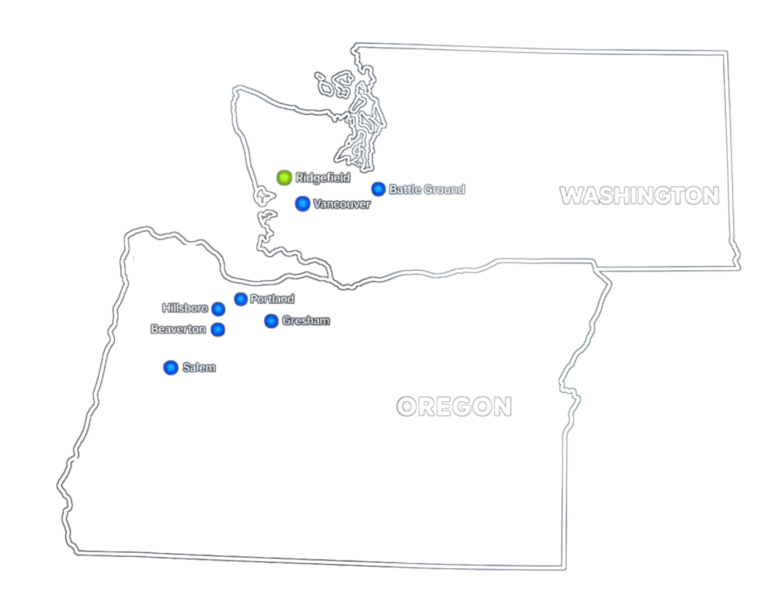
Headquartered in Ridgefield. Working across the region.
HTG runs regional work from Ridgefield, Washington, concentrated across Southwest Washington, Vancouver and the Portland metro, with work elsewhere in Oregon and Washington where service, access and scope fit.
Organizations with locations beyond Oregon and Washington can use HTG's multi-site, deployment and field-service model when broader coordination is required.
Oregon and Washington IT Services FAQ
Common questions before the first call.
Which IT services are available in Oregon and Washington through HTG?
Managed IT and user support, cybersecurity and MDR, network and connectivity, cloud calling, technology deployment, field services, procurement, lifecycle management, ITAD, consulting, staff augmentation and multi-site coordination. Each has its own page because the delivery models differ.
How do I know whether I need Managed IT Services or a project?
Managed IT fits when someone has to own users, devices, Microsoft 365, maintenance and vendors month to month. A project fits when the work has a defined result and a finish — a rollout, migration, site opening or hardware refresh.
Does HTG provide onsite IT support in Oregon and Washington?
Yes, when the work needs hands on site: field services, deployment, network installation, equipment replacement and site surveys. Onsite availability is confirmed by address, since access, timing and technician availability vary.
Can HTG work with our internal IT team or current providers?
Yes. HTG can own a defined part of the operating model, add project or field capacity, handle vendor escalation, or cover specific locations. The scope states who receives requests, who approves changes and who confirms the work is complete.
What affects the price and timing of regional IT services?
Service type, users and devices, number of locations, support hours, security requirements, travel and site access, equipment lead times, and what stays with your team. HTG settles those before preparing a proposal or project scope.
What happens after I request help choosing the right IT service?
Send your company, location and a short description of what is happening. HTG routes the request and comes back with the next step: a fit call, an assessment, a project scope or a service review.

Start With the Problem
Bring us the problem. We'll identify the owner.
Tell us what is stuck, who is affected and which providers are already involved. HTG comes back with the owning service and the next step.
Please do not include passwords, protected health information, payment-card data or sensitive incident details in the general contact form. Review HTG's privacy notice.