Data Center Infrastructure Services · Rack and Stack · Cabling · Migration and Relocation
Data Center Infrastructure Services.Planned Before the Change Window Opens.
For rack builds, migrations and relocations, HTG coordinates data center infrastructure services from the rack plan through validation and closeout, so the field team executes an approved plan instead of engineering it onsite.
Data Center Projects
Where data center projects lose control.
Most of what goes wrong in a change window was already unresolved before the crew arrived.

Rack plan
The rack plan is not ready
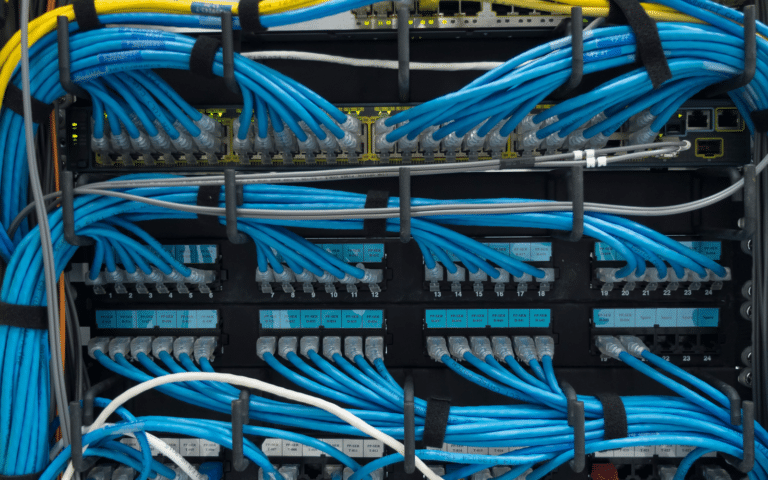
Equipment can be onsite while RU placement, rails, power, ports, optics and cable paths are still unresolved.
Sequence
Dependencies arrive out of order
Meanwhile, circuits, cross-connects, facility access, optics, hardware and change approvals usually sit with different owners.

Closeout
Power-on becomes complete
A working device is not a finished project if rack records, test results, photos, exceptions and ownership are missing.
What HTG Executes
Physical data center work, against an approved plan.
Data center infrastructure services cover the physical build, migration and connectivity work inside a facility or technical room. HTG then performs that work to a plan that has already been approved.
Build, cable and deploy
- Rack and stack, rails, RU placement and power
- Data center cabling: copper and fiber runs, labeling and assigned ports
- Servers, storage, network and security appliances installed to the approved rack and port plan, with test and as-built records
Migrate and relocate
- Source and destination readiness checks
- De-rack, pack, transport and re-rack where in scope
- Approved migration sequence, guided power cycles and swaps, validation and rollback coordination
Connect and hand off
- Carrier, cross-connect and demarc coordination
- Connectivity and failover validation against the agreed test list
- Rack, port and cable records, photos, exceptions and operational handoff
Architecture and production approval, however, stay with the named technical authority. When a project still needs the design itself, that work sits with HTG integration and engineering. Drives pulled during a refresh or move then go through HTG IT asset disposition, where sanitization methods commonly reference NIST SP 800-88 Rev. 2.
Choose the Engagement
One scheduled change, or a repeatable standard.
That difference matters because it decides how the team writes scope, records and acceptance.
A defined data center project
- Rack build, infrastructure refresh or consolidation
- Relocation, migration or colocation move
- A clear start date, change window and acceptance point
A repeatable infrastructure standard
- One approved physical standard applied across facilities
- Technical rooms, edge locations and recurring project waves
- The same records and closeout evidence at every site
How the Work Moves
Four control points before the change window.
Nothing is scheduled until the prerequisites are confirmed.
Confirm readiness
Access, rack space, power, cooling, pathways, circuits, cross-connects, hardware, optics, documentation and remote engineering cover.
Lock scope and acceptance
The task list, rack and port assignments, technical boundary, validation requirements, rollback conditions and closeout evidence.
Name the owners
Who controls architecture, facility access, technical decisions, deviations, rollback and final acceptance.
Execute and hand off
Approved work performed, exceptions raised in real time, results validated and records delivered before closeout.
Connected Services
Some of this work belongs somewhere else.
Boundaries are agreed before the project starts, not argued about during it.
Regional Planning, Multi-Site Execution
Data center projects, planned from Ridgefield.
HTG plans and coordinates data center infrastructure projects from Ridgefield, Washington, so most project work happens across Southwest Washington and the Portland metro.
Work at other locations is supported when the facility, access, technical authority, project requirements and work window can be scoped. HTG does not keep an office in every market, and onsite coverage is agreed per site rather than assumed.

Data Center Infrastructure FAQ
Questions worth settling before the project is scheduled.
What data center infrastructure services does HTG provide?
HTG performs rack and stack, data center cabling in structured copper and fiber, equipment deployment, migrations, data center relocation services and colocation moves, along with carrier and cross-connect coordination, connectivity and failover validation, and the rack, port, cable and photo records that close a project out.
What does HTG need before scheduling a rack-and-stack or data center migration project?
Facility and access details, the equipment list, an approved rack and port plan, confirmed power, cooling and pathways, circuit and cross-connect status, delivery dates, the change window, and the names of the people who approve technical decisions and final acceptance.
Does HTG design the infrastructure or execute an approved design?
In short, HTG executes an approved design. Architecture and production configuration authority stay with your engineering team or vendor unless engineering is separately in scope, in which case that work runs through HTG integration and engineering rather than being decided by the field crew.
Can HTG coordinate circuits, cross-connects and failover testing?
Yes. HTG coordinates carrier, cross-connect and demarc activity with the facility and the provider, then validates connectivity and failover against a test list agreed in scope. Provisioning timelines belong to the carrier and facility, so those dates are tracked rather than promised.
Can HTG support a migration or relocation while our engineers retain technical control?
Yes. On migrations and data center relocation services alike, your engineers keep the migration sequence, configuration authority and the rollback decision. HTG handles readiness checks, de-rack, transport, re-rack, cabling, guided power cycles and validation, and raises exceptions as they happen so the call stays with the people who own it.
What affects data center project cost, timing and closeout requirements?
Site count and access, rack and equipment volume, data center cabling scope, whether transport is included, the length and timing of the change window, carrier and facility dependencies, and how much documentation, testing and photographic evidence the acceptance criteria require.
Before the Change Window
Plan the data center work before the change window opens.
First, send the facility, equipment list, target date, access requirements and current rack and network documentation. HTG will identify the missing prerequisites and define what belongs in scope before the project is scheduled.